The Mark 1 tape
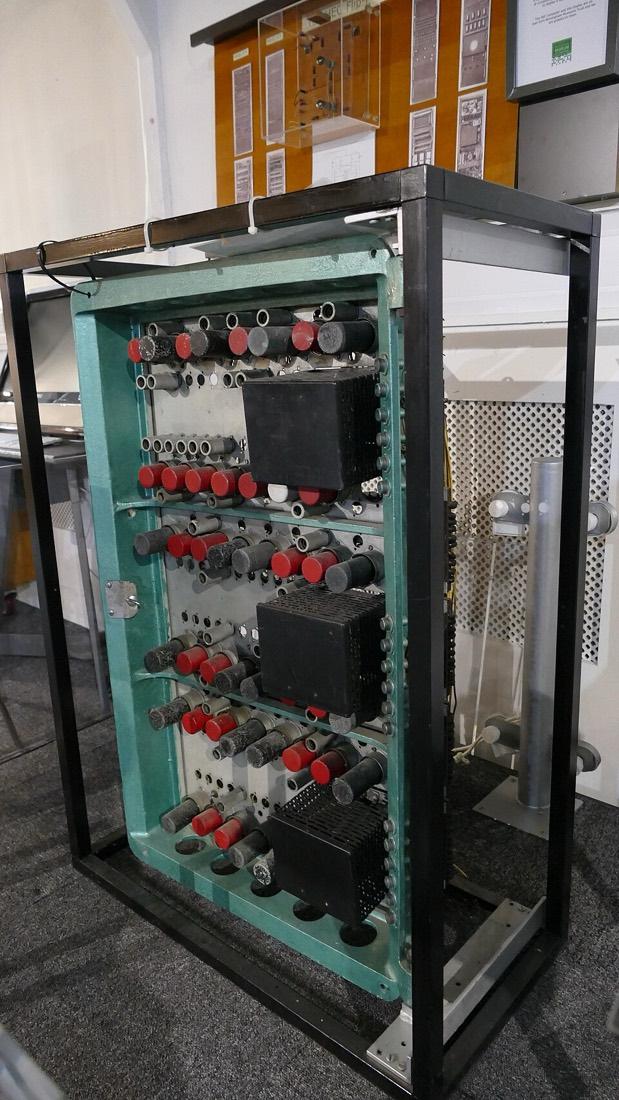
- Machine
- Manchester Mark 1
- Run by
- Alan Turing
- Run
- 1950, overnight
- Published
- 1953, Proc. London Math. Soc. 3(3)
- Result
- The first 1,104 zeros, all on the line, for heights 0 < t < 1,540. Plus 1,054 zeros near t = 25,000.
- Memory
- 25,600 bits
- Output
- Teleprinter tape, base 32
- Tape
- Our drawing from the zero heights, not his
In 1950 Alan Turing pointed the Manchester Mark 1 at the zeta function. It had 25,600 bits of memory and punched its answers out on teleprinter tape, in base 32.
It found the first 1,104 zeros and every one sat on the line. Nobody had used a digital computer to find zeros before. The machine, he wrote, “remained in serviceable condition for an unusually long period from 3 p.m. one afternoon to 8 a.m. the following morning”.
He’d wanted a machine for this since before the war. In 1939 the Royal Society gave him £40 to build a gear-wheel zeta machine. He never finished it.
There's more in the Run Data Run Deep Dive.
- In view
- 0 sign changes
- You’ve walked past
- 0 of 1,104 zeros
- Turing’s check below t = 50.0
- formula expects about 9.4, sign changes found ...
- Gram points in view
- 0, 0 breaking Gram’s rule
Z(t) is zeta, tweaked so it gives a plain number along the line. Every sign change is a zero sitting on the line. The ticks under the axis are Gram points, where you’d expect the sign to flip next. Red ticks break that rule. The first is Gram point 126. The clock spreads the night evenly over the heights, so it won’t match the real run.
How Turing knew he hadn’t missed one
A sign change proves there’s a zero on the line. It can’t show you a zero that sits off the line, because that one never makes Z change sign. You’d walk straight past it.
The fix is to count. A formula tells you how many zeros there are below any height, give or take a small wobble. If your sign changes add up to that number, nothing is hiding. The wobble is the hard part, and Turing’s trick was that it averages out to zero: check that Z has the right sign at a few Gram points in a row, and the count is pinned down.
It cost him almost nothing extra, because the machine already knew those signs from finding the zeros. It’s still the usual way the count gets done.
“may go on for a very long time before revealing its true character”